Biography
About Lord Bloggs
Lord Bloggs has served as a Life Peer in the House of Lords since 2005. Previous government service includes Secretary of State for Transport at the Department for Transport, where he oversaw major investment in rail and road infrastructure and led the department's response to national transport reform.
Since leaving government, Lord Bloggs has sat on the Crossbenches, focusing his parliamentary work on transport policy, regional connectivity, and infrastructure funding.
In Parliament
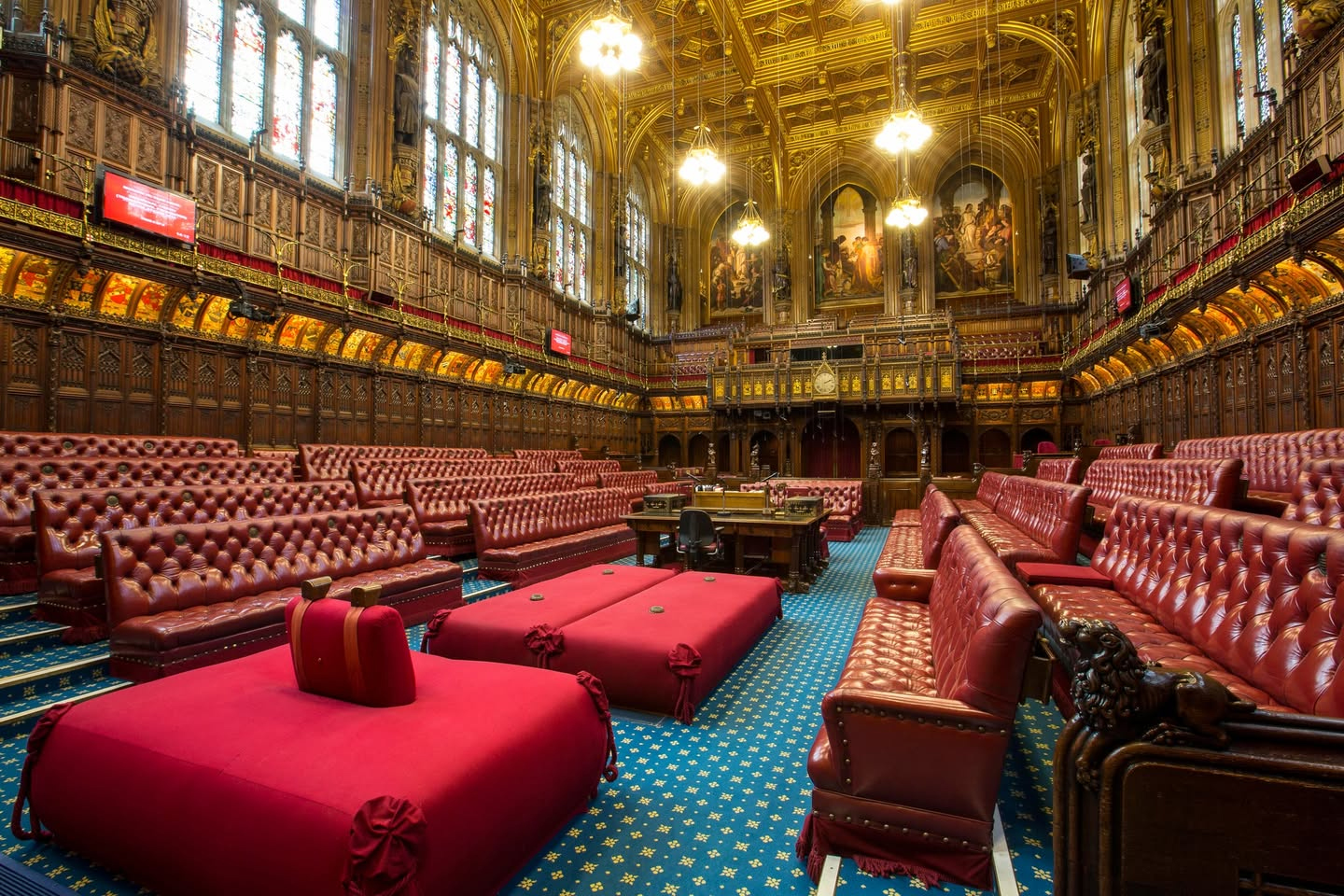
From the chamber
Focus
Areas of policy interest
- 01
Asylum, immigration and nationality
- 02
Business, industry and consumers
- 03
Economy and finance
- 04
Education
- 05
Employment and training
- 06
European Union
- 07
International affairs
- 08
Parliament, government and politics
Parliamentary work
Record & activity
Live data from members-api.parliament.uk
and lordsvotes-api.parliament.uk.
Experience
Roles & appointments- 2026 — presentCommittee
Economic Affairs Committee
- 2026 — presentCommittee
Numeracy for Life Committee
- 2026 — presentCommittee
Liaison Committee (Lords)
Lords Votes
Voting record-
Financial Services and Markets Bill [HL]
Result: Agreed
188 Content 125 Not Content -
Financial Services and Markets Bill [HL]
Result: Agreed
196 Content 138 Not Content -
Financial Services and Markets Bill [HL]
Result: Agreed
194 Content 138 Not Content -
Financial Services and Markets Bill [HL]
Result: Agreed
226 Content 162 Not Content
Spoken Contributions
Speeches & debates- 10 Sept 2026Lords Chamber Fiscal Outlook
“My Lords, I also welcome this debate. I thank the noble Lord, Lord Bridges, for bringing it and welcome the noble Lord, Lord Pitt-Watson, to his place. As for the tone of the debate, it is inevitable that the conference season, immediately before the Bud…”
“My Lords, I also welcome this debate. I thank the noble Lord, Lord Bridges, for bringing it and welcome the noble Lord, Lord Pitt-Watson, to his place. As for the tone of the debate, it is inevitable that the conference season, immediately before the Budget, is a time when all parties lay out their stall, although I have been particularly encouraged by the contribution of the noble Lord, Lord Burns, and the contribution that we have just heard from the noble Lord, Lord Hill, about some of the thoughtful longer-term structural issues with which we are contending as a nation. The nation’s fiscal challenges are self-evident, and my party in government faces understandable public anxiety. As the noble Lord, Lord Hill, just noted, the party opposite is also contending with some public scepticism about their record in government. As for what that does to our politics, it brings to the forefront the populists: those who peddle easy solutions to these structural challenges and who are determined to convince the country that the answer to our fiscal challenges is to blow up the system. It is not made any easier by the markets being spooked by a US President who, on social media last week, was telling the Federal Reserve in capital letters to lower the rate and who today promised a “cash bung” to those who voted the right way. That creates a challenge for all of us, but, as the noble Lord, Lord Bridges, recognised, the real rocket fuel for populism and difficult politics is low growth. Low growth is the root of our fiscal pressures. It is a result of the financial crisis, as we have heard, which was exacerbated in Britain by Brexit and then a series of global shocks: the pandemic, the war on our continent, the rising energy prices and the Iran conflict. There is common ground here that on top of those pressures come spending pressures of an ageing population and the need to raise defence spending. All that requires a Government willing to face up to those headwinds, and I believe that is what we are seeing. Our times demand serious responses. We have heard from the noble Viscount, Lord Chandos, about Gordon Brown and I am going to come to that, but I took inspiration this week from the noble Lord, Lord Hague, who wrote: “The old Conservative philosophy … is no longer a convincing governing programme. That is because circumstances have changed. We now face ageing populations, housing scarcity, energy insecurity, technological competition with the US and China, Russian aggression, weak productivity, strained public services and increasingly expensive welfare states”. Those are wise words indeed, and they echo what we have heard in this Chamber today. However, there was also an honest acknowledgement of the new fiscal challenges and an invocation to us all to not be tempted by easy populist solutions. His remedy was growth, particularly innovation and entrepreneurship. Gordon Brown, who wrote 24 hours later in the Financial Times, also urged a focus on growth and innovation, both men arguing for a Budget as an economic event as much as a fiscal one. Encouragingly, the new Chancellor’s inaugural speech on Monday focused on growth and innovation and scaling start-ups in the north. I will put the case for the Government. Despite the headwinds, the Starmer Government delivered the economic stability that we promised. Growth is the best in the G7. I stress that we are cutting the deficit faster than others in any other G7 economy, although I accept that a sustainable long-term path is something we have to find. Productivity is up, wages are up, business investment is rising, with planning delays, judicial reviews and the Green Book all being tackled and young people put back to work. Meanwhile, the Chancellor has reaffirmed the Government’s commitment to fiscal discipline and respect for manifesto commitments, and wisely has made no false promises on tax. I say to the party opposite, we await what the new shadow Chancellor’s prospectus is. The last shadow Chancellor told us that his strategy was not to focus on innovation—indeed, he was proposing cuts to the British Business Bank—but for a rather implausible £23 billion to come from welfare. Welfare spending outside of pensions has hovered around 5% of our national wealth for the last 40 years, so there is scant evidence of where the axe would fall. We have been told that half a million children would be pushed back into poverty by restoring the child benefit cap. That, along with raising VAT on disabled drivers and cutting housing benefits, is not the totality of the solution. Nor is cutting overseas aid. That ship has sailed. We are told asylum hotels will be cut—another ship that has sailed. Legal and illegal immigration are both decisively down. Cutting back on some of the extra 150,000 civil servants employed in the last decade and a half is perhaps wise. My point is that the luxury of opposition should not involve aping the populists, because that is not a governing strategy. We have heard from the noble Lord, Lord Burns, that the way forward may be to look at tax. We have heard from others, including the noble Lord, Lord Hill, that we should perhaps look at the triple lock. There are legitimate differences around where and how spending might be addressed and where the axe should fall, but I simply say in conclusion that we know from the Chancellor that this Budget will be one that sticks to the fiscal rules, restores the fiscal headroom, as it must, and reinforces the Government’s commitment to growth with a 10-year plan to follow which signals where change is coming on devolution, social care and defence. I believe these are the priorities that resonate with the country.”
- 08 Sept 2026Grand Committee Railways Bill
“My Lords, I apologise to your Lordships for not being here at the start of proceedings. Noble Lords put me on to the Economic Affairs Committee yesterday; it had its inaugural meeting this afternoon and it demanded my presence. I am so sorry to have miss…”
“My Lords, I apologise to your Lordships for not being here at the start of proceedings. Noble Lords put me on to the Economic Affairs Committee yesterday; it had its inaugural meeting this afternoon and it demanded my presence. I am so sorry to have missed the first two groupings, but I am here for this one. I will speak to the two amendments to which I have added my name—Amendment 117, to which the noble Lord, Lord Young, just referred, and Amendment 136, in the name of the noble Baroness, Lady Harding. My reasons for supporting them closely parallel the arguments that we have heard. I do not have the distinguished history of having been a Rail Minister, as the noble Lord, Lord Young, was—at least not in Westminster—but I had that role in the Scottish Parliament and I understand the risks of unprotected departments. Therefore, we have a duty in the Bill to consider how to protect the incredible digital innovation that we have seen in the provision of retailing services that have been widely welcomed by passengers across the country. The noble Baroness, Lady Harding, and I share a common interest in the whole area of digital regulation, as she said. The risk of leaving ambiguity surrounding the role of regulator and not putting obligations in the Bill may lead to unintended consequences down the line. I thank the Minister and officials for the recent engagement they had with noble Lords around the intent in these areas of rail retailing. I appreciate that the retail code of practice will be published prior to Report; it will go some way to allow all parties to assess whether the code meets the Government’s stated objective of fair competition in retailing.”
- 03 Sept 2026
“My Lords, I also thank my noble friend Lady Morgan. When I arrived in your Lordships’ House 18 months ago, I had just become the chair of the body that certifies every electrician—there are 170,000 of them across the country. I immediately encountered…”
“My Lords, I also thank my noble friend Lady Morgan. When I arrived in your Lordships’ House 18 months ago, I had just become the chair of the body that certifies every electrician—there are 170,000 of them across the country. I immediately encountered deep concern among employers about the fate of apprenticeships—the bureaucracy, the cost of training and the support needs of the young apprentices. This malaise deeply pained employers who had invariably come up the apprenticeship route themselves. Many noble Lords have mentioned what has happened in the last 18 months. The Milburn report published in May has been seminal. As others have said, it has been uncompromising about the moral scandal of a million NEETs, clear that young people desperately want to work and candid about the multidimensional roots of this crisis. As so often in politics, timing matters. There is not a Member among us who did not have conversations during the Recess about the future of the jobs market. Yet the public fear that politicians, in the parlance of today, “craft the narrative” or “tell the story” but too rarely stick around to solve the problem. So in my remaining time, I will talk about the momentum since the Milburn report—not on the supply side, which has dominated our discussions today about what is happening in the education system, but in stimulating employer demand. In June, it was £3,000 for employers taking on an eligible young person. In July, 22,000 defence apprenticeships were announced. In August, it was £10 billion for new affordable housing, fuelling new construction contracts. This month saw the first of 22,000 extra college places including free apprenticeship training for eligible under-25s. Next month, £2,000 will be paid to small employers for each new under-25 apprenticeship. November will see the nationwide rollout of the Government-backed job guarantee placement scheme for long-term unemployed young people. Altogether, all this ramps up and translates into half a million opportunities to earn or learn over the next three years. It is not the full answer, but it is getting closer to the scale of the challenge. But success will not just come from investment, but from effectiveness. We need to strip back misplaced red tape and substitute it with a single-minded focus on skills. I am delighted that the Government are now scrapping the laundry list of social value demands for contractors bidding for public works. The complexity was trading out to common sense. From January, job creation and skills development will be the only social value requirements on businesses competing for public contracts. The Milburn report highlighted that the Netherlands has changed the trajectory and outcomes for young people. Giving a generation back their future is a battle to be won in our time. It will be done family by family, firm by firm and postcode by postcode.”
- 20 Jul 2026Lords Chamber British Steel
“My Lords, I welcome that last answer. It is, of course, just a few minutes ago that we were discussing a Private Notice Question on the events in the Strait of Hormuz and the need for British naval support to try to keep it open. Given that our naval shi…”
“My Lords, I welcome that last answer. It is, of course, just a few minutes ago that we were discussing a Private Notice Question on the events in the Strait of Hormuz and the need for British naval support to try to keep it open. Given that our naval ships, submarines and planes all rely on steel, does my noble friend the Minister agree that, in what is self-evidently an increasingly unstable and uncertain world, acting to ensure the continuation of steel-making here at home is a vital part of our national security?”
- 14 Jul 2026
“My Lords, this is proving a fascinating and valuable debate, recognising the Bill’s many strengths, what could be tweaked, and what perhaps is missing as we look ahead. To begin with the strengths, we heard from the noble Earl, Lord Effingham, that the B…”
“My Lords, this is proving a fascinating and valuable debate, recognising the Bill’s many strengths, what could be tweaked, and what perhaps is missing as we look ahead. To begin with the strengths, we heard from the noble Earl, Lord Effingham, that the Bill builds on the work of the previous Government and commands cross-party support. We have just heard from the noble Baroness, Lady Neville-Jones, that national security is the first obligation of government. This is unarguably an important step in protecting the nation against cyber criminals, hacktivists and hostile states. It will quite simply make the UK a better place to live, work and do business in. We have heard already from the noble Lord, Lord Birt, about the economic impact of cyber attacks and from my noble friend the Minister about the 11,000 NHS appointments that are lost to cyber attacks. It therefore seems very timely that we have this Bill, which will cover more essential services, improve regulatory effectiveness, and speed up responses to cyber threats. It is clearly desirable that we have a stronger board level responsibility around cyber. It must be right that data centres are now included in the Bill, helping maintain the UK’s position as a global destination for secure data hosting and for innovation. The focus on high-impact firms means that small companies will not be unduly burdened. As my noble friend the Minister made clear, this is part of a wider national security effort that includes a cyber action plan for the public sector, a forthcoming cyber action plan for business, the Cyber Essentials certification scheme, and free cyber security support from the NCSC. All these measures will help contribute to our cyber security. The 24-hour incident reporting system will mean that regulated entities have to notify customers impacted by incidents. The tougher penalties for breaches will modernise enforcement and, I hope, improve the uptake of cyber insurance in the way that my noble friend Lady Paul has indicated is so vital. We have to hope that, together, this will mean that cutting corners will no longer be cheaper than doing the right thing. Nevertheless, given the speed at which new cyber threats are emerging, the Bill tries to strike a reasonable balance between maintaining parliamentary oversight and ensuring that the Government can act quickly, as required. I turn to the question of tweaks. Many of them have been touched on so I will not dwell further on them. We heard from the noble Lord, Lord Arbuthnot, about the importance of the workforce and the increasing demand for cyber security skills. Will the proposed codes of practice include a framework for workforce development and training? The second tweak, as many noble Lords have touched on, is to the Bill’s scope. I have some sympathy with the noble Baroness, Lady Northover, about the case for closer alignment with EU regulations when we have British companies operating and complying with EU legislation in the areas that are covered. I also think that a broader scope would drive the sort of behavioural change that my noble friend Lady Paul cited. I note that the Minister already said that secondary legislation is available to expand the scope. I look forward to her comments on why we do not have a broader scope now, given the groundswell already in this debate, perhaps to include public administration, in particular local government, given the scale and sensitivity of data and the essential nature of public services. The third tweak is something else that has been widely noted already: the risks associated with having 12 regulators. I appreciate that the Government’s intent is minimising regulatory upheaval. There is a balance to be struck. The noble Lord, Lord Birt, approached the issue of risk from the desire and need to ensure expertise. I will look at it through the lens of the risk of duplication. At lunchtime today, I spoke at a NED event hosted by a US law firm that counts among its clients a major cloud provider, insurance companies, professional services firms and a board effectiveness practice that works with both public and private sector organisations. The strong consensus in the room was that a common cyber security standard across all regulators, upon which appropriate sector-specific requirements could be layered, merits consideration. This approach is in the spirit of the Government’s amendments, tabled in the other place, to streamline reporting and avoid unnecessary complexity. I hope that issue is given further consideration. In my few remaining minutes, I will touch on what is not in the Bill. As others have noted, technology is advancing faster than government frameworks can keep pace with it. The Bill was published last year, just as it became clear that AI was tipping the advantage to attackers. Attackers need to succeed only once, while defenders potentially need to patch millions of users. There is currently no technology to automate patching at the pace required. The Bill needs to say more on the role of integrating AI tools into cyber defences. The Bill arguably has an AI-shaped hole in it, although I am encouraged that the incoming Prime Minister has signalled a fresh look at AI regulation. Even Sam Altman, faced with a capricious President, has come round, writing in the FT that “citizens and their elected representatives must make the rules”. We have also seen the Five Eyes intelligence partnership warning in a very rare joint communiqué last month that the West’s adversaries were within months of developing cyber attacks that could overwhelm the defences of Governments and companies and noting that frontier AI models will fundamentally transform cyber capabilities. All this is now with us, so raising our defensive capability in the face of this rising AI functionality will be essential. Our spy chiefs are asking western companies to use AI models to strengthen their defences. I fully appreciate that the Government are completely across this threat landscape. The question is: how do we collectively legislate or regulate in such a threat landscape? Some suggestions that we can consider in Committee are, first, that advanced AI providers could perhaps be designated as covered entities under the Bill. Secondly, since the impact of AI in the cyber field is increasingly systemic rather than sector specific, perhaps we need common AI cyber security guidance supporting all regulators in this fast-moving landscape as they then layer on the needs of their sector. Thirdly, perhaps there should be an AI field in the mandatory incident reporting regime. Finally, we should perhaps think about an AI oversight framework giving the NCSC more teeth and the AISI a more co-ordinating role. In conclusion, as widely recognised, the Bill will support our economy and our people and make the country safer. It is part of a package. It is a crucial building block rather than the final destination. I strongly commend it to the Chamber.”
- 07 Jul 2026Lords Chamber Railways Bill
“My Lords, like the noble Baroness, Lady Grey-Thompson, I am going to start with a personal anecdote, but it will not be either as moving or as consequential as the ones we have heard from her today. I pay tribute to her campaigning work on this issue; I…”
“My Lords, like the noble Baroness, Lady Grey-Thompson, I am going to start with a personal anecdote, but it will not be either as moving or as consequential as the ones we have heard from her today. I pay tribute to her campaigning work on this issue; I am sure that sentiment is shared by other Members of the House. On a Friday, when I get to Euston and am heading north, I yearn for the toilets to work, effective wifi and a quiet coach. By the time I get back to London on a Monday, as a commuter, I am looking at “Am I going to get a seat? Is it reliable? Is the price fair?” Of course, a top-class railway that is spending £22 billion annually—with more than half of that taxpayer subsidy—arguably can and should provide all these things and more, and I have not even mentioned the other neglected priorities of electrification, extreme weather resilience, modal shift, new services, safety, speed, fresh sandwiches and so on. All these competing ambitions make a wider point in that they concern the choice of priorities, yet the essence of the claim in the Bill is that the delivery of future policy priorities can follow only from getting the basic underlying structure right. The Bill is a fresh start. It legislates for an outcome that the Conservatives recognised the case for but did not act on: the need to end the fragmentation and to bring track and train together. The noble Baroness, Lady May, graciously hinted at the value of bringing track and train together. I share her concern for passenger voice as a live issue and regional influence, but I am mindful that I am to be followed by the noble Lord, Lord Redwood, who I anticipate having a slightly more ideological engagement about the merits of privatisation versus nationalisation; I promise to say a word on that later. I think that the public’s first concern is simply a service that works. The Bill builds around an evidence case that fragmentation is holding our railways back. The Minister noted that we have 17 different bodies, so unifying track and train under a single organisation is designed to work for passengers, freight and the taxpayers. For the first time in a generation, we will have a single arm’s-length body that is unambiguously accountable for making the railways work. Of course, a new structure could potentially drive out the very large existing inefficiencies, and it is the prerequisite for dealing with the prevailing culture, which is one of blame, then negotiation and then compensation. Despite those vital changes, the trade-offs between affordability and reliability, and between subsidy reduction and network upgrades, will remain, so I welcome that, when it comes to setting priorities, the Government have given us a flavour. They are about to publish a long-term rail strategy that will have five core objectives, two of which will deal with long-term economic growth and reducing regional inequality. We need to reorientate our railways to our long-term ambitions for the nation. Two hundred years ago, railways were the new general-purpose technology of their day. Today’s general-purpose technology is AI, and quantum will follow. Again, we face as a country the creative destruction that is changing our economic geography in the same way as railways first shaped our economy, our geography, our leisure and our landscape. Great British Railways should be tasked with supporting a faster-growing economy. This is a time of profound change. We need it to break down barriers of opportunity, reduce journey times, improve connectivity and stimulate regeneration and housebuilding next to stations. Let me come beyond the rhetoric, to the relief of the other side, to the challenges that come with establishing a single organisation. Great British Railways, when it is fully established, will employ 100,000 people. It will be the country’s largest arm’s-length body. The stakes are high. On the plus side, public ownership avoids the siphoning off if dividends and profiteering. However, we must also mitigate the known risks. Monolithic organisations can be deaf to key interests, captured by other interests, slow to innovate and risk averse. These are not insuperable challenges. Many nations manage to have fast, reliable, successful railway systems, and so should the nation where it all began. The structural changes will need to be coupled with political and organisational leadership. To meet public expectations, we will need better regulation rather than more regulation. To encourage the self-sufficiency of the system and manage the burden on the taxpayer, the House of Commons Transport Select Committee suggested that we should be setting a passenger growth target to incentivise commercially minded improvements. When it comes to nurturing innovation, the Minister will be aware of the ongoing anxieties, notably from the open access operators. They account for only 1% of services but they are responsible for 19% of the new train orders in recent years, so we need to make sure that they find their place. They have been successful in securing modal shift on the Edinburgh to London route and elsewhere. In my few remaining minutes I come to the issue of devolution of decision-making, clear accountability and speed of decision-making. This touches on some of the anxieties that the noble Baroness, Lady May, raised about regional input. Britain’s devolution landscape is complex, highly varied and very fast evolving. Others have referenced the new Member for Makerfield. I welcome that the Bill provides for the devolved Governments in Wales and Scotland and the combined mayoral authorities to have a statutory role in the rail network, but I would welcome reassurance on how this will work in practice. Can we expect to see any of the mechanisms for clear accountability, locally and nationally, during Committee? As a signal of intent of their commitment to working with the devolved Governments and mayoral authorities, will the Government look at developing shared evidence bases that will allow for the stronger business cases that will allow us to move over time to local commissioning? Finally, on ticketing, I will say only that it must be right to consolidate 55 million different ticket types that are allegedly available and make it easier for the passenger to find the most affordable fare. In conclusion, I say that this Bill is a bold statement. That is important. It is not always that Members on this side can stand and say, “This is a bold statement about the way forward”. We as a Government have been accused of timidity. This is a bold statement to fix a problem that has frustrated passengers, railway staff and the railway industry for too long. It begins a process of evolution from today’s semi-privatised rail network to a nationalised railway, but the essence is to bring track and train together and end 30 years of experimentation, unlocking growth and delivering efficiency in the network. I commend the Bill and look forward to Committee.”
Written Questions
Questions to government- Treasury
To ask His Majesty's Government what changes they have made to the HM Treasury Green Book in the last two years; and what was the purpose of each change.
Lord Livermore
TreasuryHM Treasury concluded its review of the Green Book in June 2025. Since then, it has published a clearer, shorter Green Book, ensuring decisions are no longer based solely on single metrics such as benefit-cost ratios (BCRs), but instead consider the full range of potential impacts.
HM Treasury has streamlined business case guidance, and has published the findings of an independent review into the Green Book discount rate, ensuring the government is taking a fair view of long-term investment proposals.
HM Treasury is also piloting place-based business cases (PBBCs) with four early adopter locations, working in close partnership with regional, local and devolved governments, including mayors, to test a new approach to appraisal that puts local objectives at the centre. Business cases for major projects and programmes are being published consistently, meaning the public can have confidence that every pound of taxpayers’ money is being spent on projects that deliver the best possible value.
HM Treasury has published a report on its progress in implementing the conclusions of the Green Book Review in 2025. The report can be found here: https://www.gov.uk/government/publications/green-book-review-2025-one-year-on
- Department for Science, Innovation and Technology
To ask His Majesty's Government what sovereign AI systems or partnerships they are pursuing to reduce dependence on US company frontier models.
Baroness Lloyd of Effra
Department for Science, Innovation and TechnologyThis Government takes AI sovereignty and security extremely seriously.
We are investing £500m in UK AI firms via our SovAI Fund, including in home-grown model developers, like Ineffable. This goes beyond just funding, to include support such as visas and procurement.
Sovereignty is not just about access to AI models. It is about building leverage over key parts of the value chain, such as AI hardware. That is why the Government has announced a £1.1 billion AI hardware plan.
Security is also fundamental to the Government's approach. Our AI Security Institute is world leading, and one of a handful of organisations with access to Mythos before release.
This means the UK is not a bystander. Canada, France, Germany and elsewhere recognise our leadership, and want to work with us to build sovereign assets and learn from our approach to risks.
- Department for Science, Innovation and Technology
To ask His Majesty's Government what assessment they have made of the implications for the United Kingdom's access to frontier AI models, in the light of the United States' decision to restrict access to Anthropic's most recent Mythos and Fable systems.
Baroness Lloyd of Effra
Department for Science, Innovation and TechnologyThis Government takes AI sovereignty and security extremely seriously.
We are investing £500m in UK AI firms via our SovAI Fund, including in home-grown model developers, like Ineffable. This goes beyond just funding, to include support such as visas and procurement.
Sovereignty is not just about access to AI models. It is about building leverage over key parts of the value chain, such as AI hardware. That is why the Government has announced a £1.1 billion AI hardware plan.
Security is also fundamental to the Government's approach. Our AI Security Institute is world leading, and one of a handful of organisations with access to Mythos before release.
This means the UK is not a bystander. Canada, France, Germany and elsewhere recognise our leadership, and want to work with us to build sovereign assets and learn from our approach to risks.
- Department for Science, Innovation and Technology
To ask His Majesty's Government what assessment they have made of the scale of public investment needed to maintain meaningful UK sovereignty in AI infrastructure.
Baroness Lloyd of Effra
Department for Science, Innovation and TechnologyFor Britain, AI sovereignty is about reducing over-dependencies and increasing resilience in key national strategic priorities, so we secure greater control and greater leverage over the issues that matter most. We will continue to use the best technology and welcome inward investment because that is what our public services and economy demand.
We recently announced a £1.1 billion AI Hardware Plan to back British firms developing the chips and computing power behind AI. This includes our Advance Market Commitment to buy novel inference chips, which will equip the UK’s AI Research Resource (AIRR) with powerful next generation chips. Dedicated AIRR capacity supports the AI Security Institute and the Sovereign AI Unit, including guaranteed resource for mission-critical AI safety research, and strategically selected UK AI startups. Over 500 UK projects have already been supported through AIRR infrastructure, and we are further investing £2 billion to expand our public compute offering.
- Cabinet Office
To ask His Majesty's Government what progress they have made in setting up taskforces to improve government delivery.
Baroness Anderson of Stoke-on-Trent
Cabinet OfficeGovernment has started the first two pilots of these taskforces. One that will improve data sharing across the criminal justice system with work taking place between the Ministry of Justice and the Home Office and a second to address violence against women and girls by working to accelerate delivery of support services in communities across the country.
- Department for Science, Innovation and Technology
To ask His Majesty's Government what assessment they have made of the potential impact of increasing levels of AI adoption on public sector efficiency.
Baroness Lloyd of Effra
Department for Science, Innovation and TechnologyThe Government recognises the significant potential for artificial intelligence (AI) to improve public sector efficiency and productivity.
Analysis undertaken through the State of Digital Government Review indicates there is up to £45 billion per year in potential gains, including up to £36 billion from simplifying and automating delivery. Initial analysis by the Central Digital and Data Office found that baseline spend could be reduced by 31% through the use of AI. However, this is an estimate of opportunity, rather than a forecast or committed saving.
Register of Interests
Declared interestsCategory 1 Remunerated employment etc.
- Member, UK Advisory Board, ApplyBoard Inc (education technology)
- Member, Investment Advisory Board, Scottish Equity Partners LLP
- Chair, Joint Industry Board for the Electrical Contracting Industry
Committees
Committee memberships- Member · Current
Economic Affairs Committee
2026 — present
- Member · Current
Numeracy for Life Committee
2026 — present
- Member · Current
Liaison Committee (Lords)
2026 — present
Get in touch
- Phone+44 (0)20 7219 5353
- AddressHouse of Lords, London,
SW1A 0PW, United Kingdom